

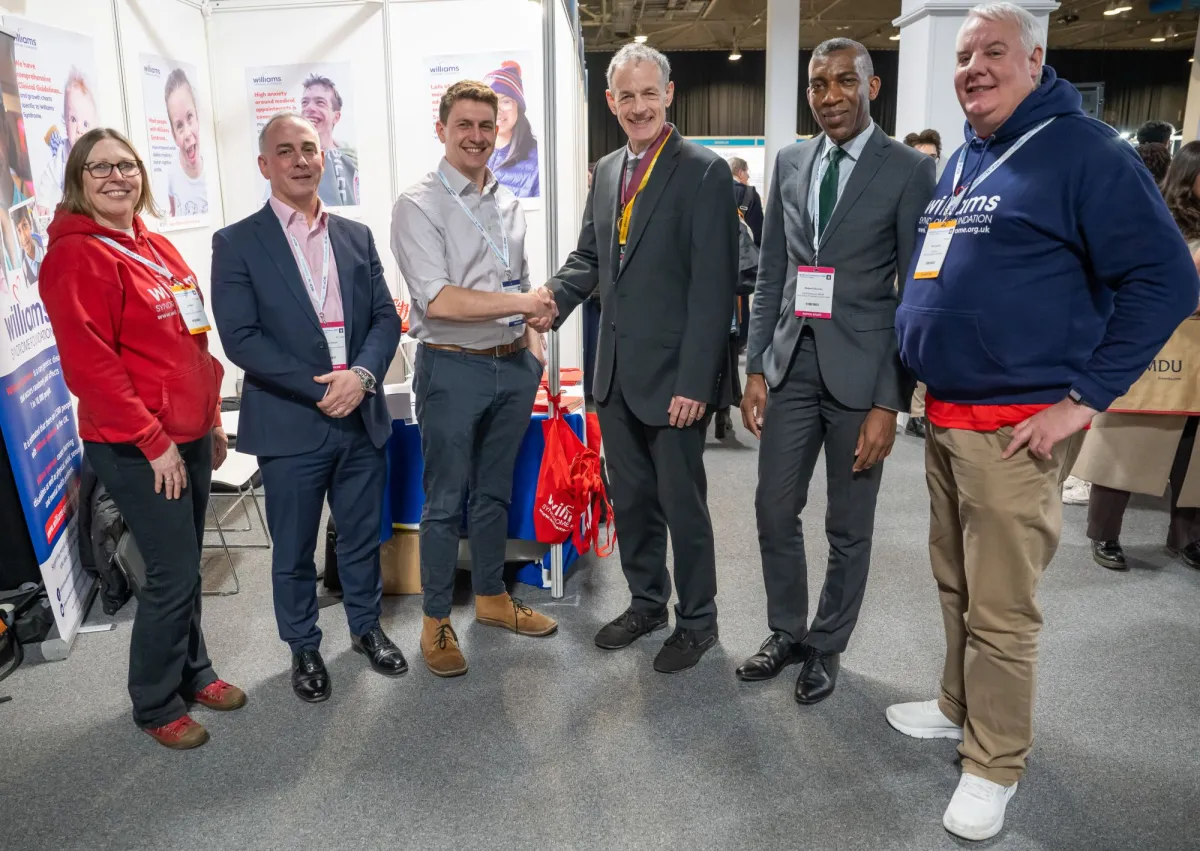
Dr Thomas (Tommy) Isaac is a neonatal trainee (ST7+), based in the Southwest. Tommy is currently out of programme and is interested in research on neonates, their brain development, and what we can do to best set them up for life through the care we provide during their perinatal journey. As infants born preterm are at increased risk of developmental challenges, Tommy is keen to understand what we know about this, why it happens and what can be changed to improve outcomes. Tommy's paper, Measuring the Impact of Deprivation on Learning Difficulties and Behaviour Among Infants Born Preterm: A Cohort Study, explored the relationship between preterm birth, social deprivation and learning difficulties, helping to shed light on how these factors interact to influence longer-term outcomes.
One year on from receiving the Williams Syndrome Foundation Cooper Bursary, we caught up with Tommy to learn more about the progress of his research, his research journey and what the award has meant to him. In the interview, Tommy discusses how research informs his clinical work and how his clinical work, in turn, shapes his research. Tommy also reflects on the importance of challenging the status quo and describes research as a process of passionate, careful inquiry.
What motivated your clinical research focus?
My original academic background was in neuroscience, so I've always been interested in brains. What drew me to neonatal research is that there is this really interesting window where lots of things are happening, and there are lots of modifiable factors that might influence how the brain develops.
Neonates also provide really rich data. We collect a huge amount of information about babies, although it's not always brought together particularly well. That's quite a lot of the job of research, really. The data is there and we can work with it.
The other thing is that babies are at the very beginning of their life course. If someone encounters challenges later in life, there are lots of other factors that may have played a role, which can make the scientific question more difficult to answer. With neonates, you often know what happened during pregnancy and what happened after birth because we monitor them so closely.
Then, from the social deprivation side, you're adding in a factor that's harder to pin down. We don't have as much direct data, but we have proxy measures. In this study, we used postcodes as a geographical measure of social deprivation. I think it's really interesting to look at how these things interact. Social context helps us understand the broader picture, but as clinicians we're also interested in what we can influence more directly. Research is often about understanding where those two things meet.
Thinking back to the start of your research journey, what inspired you to pursue research and what continues to motivate you today?
Anyone involved in healthcare, particularly child health, wants to make people's lives better and reduce the impact of illness and disease. You can do a lot of that at the coalface as a clinician, but research felt like an opportunity to do that on a broader scale, and that's what first motivated me to get involved.
I started out doing quality improvement work, which focused on translating research into practice. That then got me thinking: what questions would I actually like answered? What things might change the way I practice?
That sort of inquisitive questioning goes both ways. Once you get involved in research, it makes your clinical work better because you understand more about why you're doing the things you do day to day. At the same time, clinical practice gives you new research questions. It's a bit of a self-perpetuating cycle, and that's what I really enjoy about it.
Since then, I've tried to seek out academic opportunities that allow more time for research. Lots of people would like to do research, but it can be difficult to find the time to step back and think about those questions alongside the pressures of clinical practice.
Since receiving the award, how has your research progressed? Have you taken on any new or additional projects?
Since receiving the award, I applied and I'm now completing a fellowship based at the Neonatal Neuroscience Lab at the University of Bristol. The fellowship includes protected research time, equivalent to one day a week.
The main project I've been working on looks at how HIE (hypoxic-ischaemic encephalopathy), a brain injury usually caused by a lack of oxygen around the time of birth, affects sleep later in life. That's been really interesting because when people think about brain development, attention is often drawn to things like walking, talking and educational outcomes. But there are all these other things the brain does for us that are closely linked. For example, how you sleep affects how you perform in school. These are areas where we can start to think about how best to support children and families from a care perspective.
The award has also funded my attendance at an international conference, where I'll be presenting this work later this year, which is really exciting and something I'm very much looking forward to.
Alongside that, I've been preparing an application for a PhD. As part of that work, I'm setting up a patient and public involvement (PPI) group for parents of children who have undergone surgery, and funding from the award has helped support this as well. It's been really helpful in allowing me to explore a number of different avenues and develop my research further.
How do you involve paediatric patients and families in your research and what impact has this had?
Working with children and their families is critical for research. In neonatal research, PPI most often involves parents and families because babies can't communicate their experiences themselves. As children get older, those who were born preterm can provide valuable insight into the longer-term impact of those early experiences. Around one in 10 babies are born preterm, so there are lots of people who can offer that perspective. For my work, though, we primarily work with families to understand their experiences and help advocate for the experiences of their children.
With our parent advisory group, we're planning to explore pain relief following neonatal surgery. We know babies experience pain after operations, but pain management in neonates hasn't been studied as extensively as it has in adults. We need a better understanding of the medications we're using and their potential longer-term effects.
The parent advisory group will help us co-develop the research questions and identify the areas that matter most to families. That's really important because it helps ensure we're asking questions that are genuinely relevant to the people most affected.
What have been the key learnings or highlights from your research journey so far?
One of the biggest highlights has been the piece of work I was fortunate enough to receive the award for, which looked at how prematurity and deprivation interact in terms of the risk of developing learning difficulties later in childhood.
The key finding was that both prematurity and social deprivation are significant risk factors for learning difficulties, but they don't appear to amplify one another. Instead, they seem to act additively but our not greater than sum of their parts for the majority of specific learning difficulties.
That was an important and exciting finding because it reinforces what we already know, that social deprivation affects health and development and, in this case, has an impact on learning difficulties. However deprivation doesn’t magnify the other risks babies born preterm face.
It's also interesting because it has implications beyond healthcare. We're living in a time when increasing numbers of families are being affected by deprivation. As paediatricians, we want to do what we can to improve that, but we also know that wider societal change doesn't happen quickly.
What I find encouraging is that it shows the work we do day to day still makes a real difference. In this case, providing excellent neonatal care gives preterm babies the best possible chance of good neurodevelopmental outcomes, whatever circumstances they're coming from. I think that's quite an inspiring message.
What are your plans for the next stage of your research career?
I'm currently applying for funding through the NIHR Doctoral Fellowship programme to look at what the best pain relief options are for babies following surgery during neonatal care.
That's important because we want to manage pain as effectively as possible, while also being mindful of how the treatments we give these vulnerable patients may affect them in the longer term.
I think it's always worthwhile questioning the status quo. If you find that the current approach is the right one, that's great, but you still need to keep coming back to these questions and testing your assumptions.
Pain and its effect on development, particularly in neonates, is an area that has attracted increasing interest over the last couple of decades, and our understanding of pain in babies has changed enormously during that time. Because of that, it feels like the right time to look at these questions more closely.
From the other side, I have been working with Archives of Disease in Childhood, as a Trainee Assistant Editor for the Education and Practice Edition. I have really enjoyed getting involved with research from the editorial side.
What advice would you give to aspiring researchers starting out in this field?
I've had a slightly less traditional research journey than people who follow a dedicated academic training pathway. It can sometimes be quite easy to feel discouraged if you're not on a pathway where research opportunities are regularly presented to you.
My advice would be not to be afraid to put your head above the parapet. It can feel a bit daunting, but there are opportunities out there, and finding academic mentors can make a huge difference.
Research is happening in hospitals and healthcare settings across the country, so a great place to start is by finding out who in your department is involved in research and asking how you can get involved. Most researchers are incredibly enthusiastic about supporting people who are interested and helping them take those first steps.
Another good place to look is Trainee Research Networks. There are the RCPCH Trainee Research Networks as well as specialty-specific networks. I do some work with NeoTRIPS, which is a trainee research network for people interested in neonatal research.
They're a really good way to gain experience, understand what research involves and get involved in projects. Having that experience on your CV also helps later on if you're trying to carve out more dedicated research time, because it shows that you genuinely care about it and have started building that understanding.
If you could sum up research in three words, what three words would you use?
Passionate, careful, inquiry.
From exploring the long-term outcomes of preterm birth to developing the next stages of his research career, Tommy's journey demonstrates the opportunities that research can create. Applications for the Williams Syndrome Foundation Cooper Bursary 2027 are now open. Find out more about the award and how to apply