
Introduction
Clinical outpatient experience is a core component of paediatric training and is essential for the development of safe, effective, and independent paediatricians. Skills in managing an outpatient caseload take time and practice to develop and must evolve progressively throughout training.
As most consultant general paediatricians spend a significant proportion of their working lives in outpatient settings, paediatric training must reflect this reality by embedding high quality outpatient experience within resident doctors’ work schedules.
Present feedback from resident doctors and their supervisors highlights lack of formal structure to aid development of these skills, disparity in exposure to outpatient clinics and often an emphasis on acute ward-based work at the expense of outpatient exposure. These standards seek to address these challenges constructively and broaden access to outpatient clinics for all general paediatric resident doctors.
Outpatient training aligns closely with the General Medical Council (GMC) duties of a doctor and the RCPCH Progress+ curriculum, which emphasise capability-based development, longitudinal learning and increasing autonomy under supervision.
Educational value of outpatient experience
Paediatric outpatient clinics provide unique learning opportunities that complement inpatient and acute care exposure. They enable resident doctors to develop diagnostic reasoning, risk assessment and management planning in a setting that supports longitudinal follow-up and holistic care.
Resident doctors learn to triage, balance investigation and reassurance, manage uncertainty, write clinic letters and coordinate care across services.
Outpatient work also promotes continuity of care, allowing residents to observe disease progression, treatment response, and the wider psychosocial impact of illness on children and families: key elements of general paediatric practice.
Alignment with the Progress+ curriculum
The RCPCH Progress+ curriculum emphasises the development of capabilities across multiple domains that are optimally achieved through outpatient experience, including:
- Clinical assessment and diagnostic reasoning for common, chronic, and complex paediatric conditions
- Communication and partnership, including shared decision-making with families and engagement with children and young people
- Health promotion and illness prevention, such as growth monitoring and developmental surveillance
- Safeguarding and child protection, including recognition of psychosocial complexity
- Leadership, teamwork, and system working, through coordination of care and follow-up planning
Specific learning outcomes and key capabilities relating to outpatient experience within the Progress+ curriculum include:
- Generic core curriculum: Learning outcome 4, Key capability 2: Recognises and manages a range of common childhood outpatient conditions
- Generic Specialty curriculum: Learning outcome 4: Considers the full range of differential diagnosis, treatment and management options available, including new and innovative therapies, in inpatient and outpatient settings as relevant to <GENERAL PAEDIATRIC/SUB-SPECIALTY>; anticipating the need for transition from paediatric services and planning accordingly
- General Paediatrics specialty curriculum: Learning outcome 3 and all key capabilities: Recognises, investigates, initiates and continues the management of the full range of acute and chronic health problems presenting to paediatric outpatient clinics, drawing upon the expertise of other specialists, as necessary
To achieve the above, we recognise outpatient experience as an essential longitudinal learning opportunity, which should be built upon throughout training.
To ensure equitable access and educational value, we recommend that it is planned, protected, and incorporated into resident doctors’ work schedules, rather than being opportunistic.
Progressive model of outpatient experience across training
Outpatient experience should develop in a structured and graduated manner, reflecting increasing competence and autonomy as residents progress through their training.
Indicative clinic frequency applies to full-time residents, excluding periods of leave or night shifts, with pro-rata adjustment for those working less than full time.
Clinic templates should be designed and adjusted to suit the level of training of each individual resident doctor - appreciating that the prior experience, confidence and competence of an individual resident doctor at any given level of training can vary. The templates should include, where needed, time before during and after the clinic for active support from the supervising consultant or associate specialist.
As training progresses, senior residents should be supported to develop skills in reviewing and triaging outpatient referrals, as well as responding to advice and guidance requests.
This diagram outlines the outpatient experience by training level (all clinic numbers based on full time equivalent)
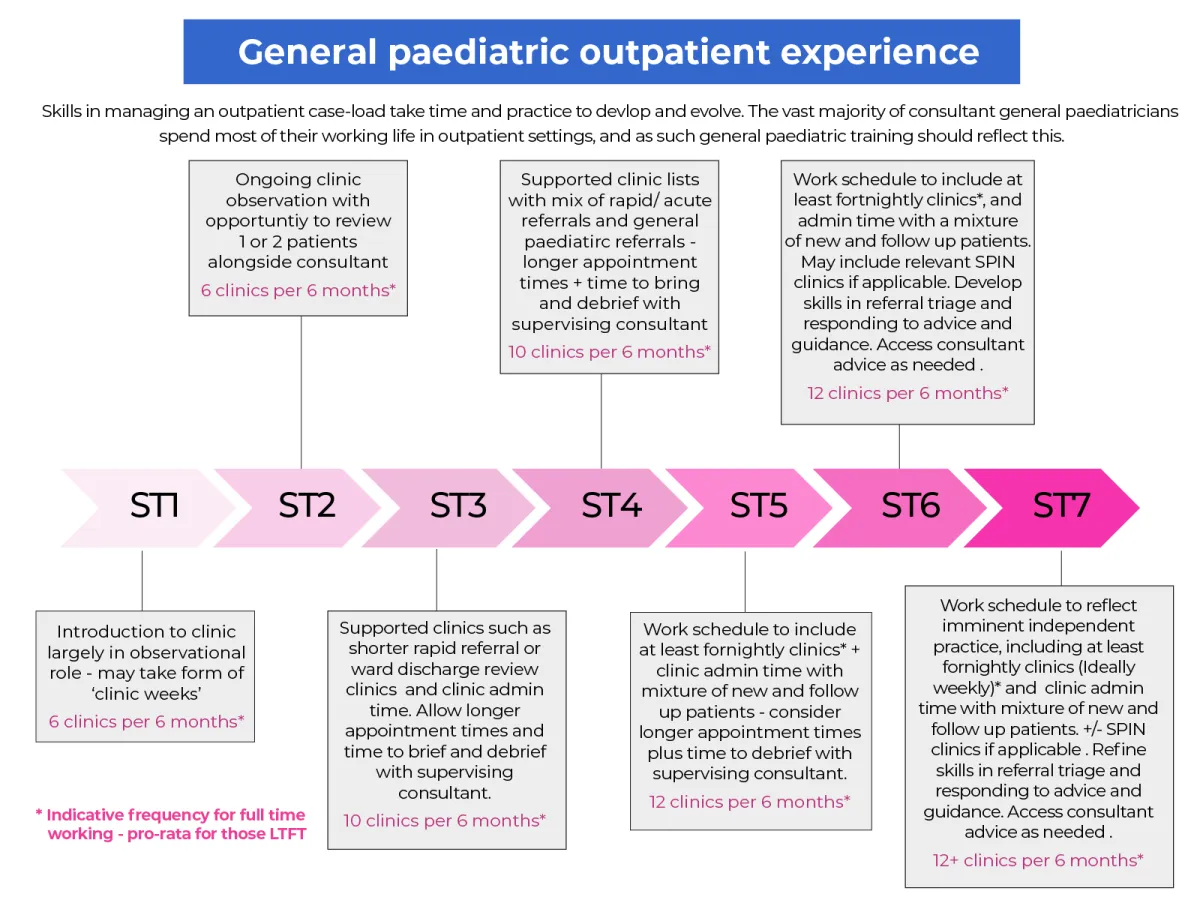
- Early training (ST1–ST2): minimum six clinics per six months
Outpatient exposure is focused on allowing residents to become familiar with clinic structure, patient flow, documentation, and communication. This may initially take the form of dedicated “clinic weeks” or attendance at selected clinics alongside a consultant.
Residents may begin by observing consultations and move to reviewing one, two or in some cases more patients with supervision, supporting early skill development in a low-risk environment.
- Core training (ST3–ST4): minimum 10 clinics per six months
Residents progress to undertaking a range of clinics with support, including rapid referral, general paediatric, or ward discharge review clinics. Longer appointment times allow for assessment, discussion, and reflection.
Protected time is provided for debriefing and case-based discussion with the supervising consultant, supporting development of clinical reasoning and decision-making.
- Middle to senior training (ST5–ST6): minimum 12 clinics per 6 months
Outpatient work becomes a regular and planned component of the resident’s job plan, typically including fortnightly clinics with associated clinic administration time. Residents should be given the opportunity to review and triage referrals with support, alongside consultant colleagues.
Residents manage a mixed caseload of new and follow-up patients, developing confidence in longitudinal care, safety-netting, and shared decision-making.
Appointment lengths may still be adjusted to support increasing complexity and autonomy with protected time to discuss patients before/after clinic with the supervising consultant.
- Senior training (ST7): minimum 12-plus clinics per six months
In the final stage of training, outpatient experience aims to replicate consultant working patterns. Residents should be given the opportunity to review and triage referrals and respond to advice and guidance requests with support.
Residents are expected to run at least fortnightly clinics on average, with associated clinic administration time, managing more complex caseloads with a high degree of independence. Where possible, they should be given the opportunity to see patients longitudinally if follow up is required. Where appropriate, this may include SPIN (Special Interest Modules) or specialist clinics, with supervision focused on readiness for independent consultant practice.
Conclusion
Clinical outpatient experience is an essential pillar of paediatric residency training. When delivered through a structured, progressive model and embedded within resident work schedules, it enables residents to meet GMC professional standards and achieve RCPCH curriculum capabilities.
High-quality outpatient exposure supports the development of competent, reflective, and compassionate paediatricians prepared for independent practice and the delivery of safe, family-centred care across healthcare settings.